



insurance
Investigation into Organized Insurance Fraud: Ring Broken Up
When a set of files reveals a structured pattern
Organized fraud differs from isolated fraud in that it is characterized by repetition and a structured approach. A single individual appearing in multiple cases, claims with identical patterns spread across several companies, and complex financial schemes: these are all scenarios that go beyond the scope of an investigation into a single case.
Organized fraud networks are constantly evolving. Serial false claims, genuine claims that are systematically overvalued, the use of straw men, the involvement of the same consultant in cases with common signatures, and internal collusion within insurance firms: the types of fraud are diversifying and require a rethought investigative approach.
The firm handles these cases by cross-referencing multiple files, analyzing connections between parties, and conducting coordinated field investigations across several geographic areas. This approach is made possible only through the collaboration between the Insurance Investigation Division and the Aquila Group’s OSINT Division.
The stakes for insurance companies go beyond recovering wrongfully paid claims in an isolated case. Early detection of a network makes it possible to prevent future fraudulent claims filed by the same perpetrators, to alert sister companies via ALFA channels, and to lay the groundwork for potential criminal prosecution of the key organizers. The report produced by our firm is designed to support these three purposes.
Warning Signs of an Organized Fraud
- The recurring involvement of the same individual (consultant, witness, mechanic, technical advisor) in several of the company’s cases.
- Profiles of insured individuals with structurally similar characteristics (age, circumstances, type of policy, amount).
- Incidents with nearly identical scenarios occurring at different times and in different places.
- An unusual geographic concentration of incidents of the same type within a given area.
- Evidence of links between seemingly independent policyholders (shared addresses, affiliated companies).
- Suspicious developments in a case after it has been opened (change of attorney, new evidence surfacing belatedly).
What the survey includes
organized fraud
The investigation is conducted on three complementary levels: structured document analysis, coordinated field operations, and operational synthesis.
Mapping of stakeholders: insured individuals, recurring witnesses, professionals involved in the process, and associated service providers.
Cross-referencing across multiple cases involving claims with common characteristics (locations, amounts, scenarios, parties involved).
In-depth background check: history, multiple statements, affiliated companies, suspicious transactions.
Coordinated field deployments in the key players’ identified areas of operation.
Targeted interviews with peripheral figures (witnesses, intermediaries, former employees, service providers).
Open-source investigation by the OSINT unit: links between actors, legal structures, and public profiles.
A summary that can be used for litigation purposes or to report issues to the authorities via ALFA channels.
Each organized fraud case is subject to a specific framework at the start of the investigation, with a precise definition of the scope, the evidentiary objectives, and the timeline.
ANONYMIZED CASE STUDY
Serial disaster network
multi-company
An ALFA alert revealed twelve auto insurance claims filed with eight different companies over a period of fourteen months. Our analysis reveals that the same auto repair shop expert was involved in seven of the cases, and that two recurring witnesses appeared in multiple scenarios. Field investigations conducted across three regions identified a front company that served as a cover for six of the policyholders. Cross-referencing of documents establishes a link between the key figures through a previous shared business activity. The summary report, forwarded to the insurance companies involved and to ALFA, forms the basis for several parallel legal proceedings.
The Process of an Organized Fraud Investigation
The initial scope definition is critical: it establishes the scope, timeline, and measurable objectives. Our methodology adapts to the complexity of the project.
01
Framing
Defining the scope of the investigation with the client company: scope, relevant files, key objectives, and tentative timeline.
02
Constitution
Creation of a multi-case analysis database and identification of documentary links between parties and between claims.
03
Deployment
Coordinated field deployment across the key players’ areas of operation, with joint mobilization of the Investigation, Intelligence, and OSINT units.
04
Consolidation
Consolidation of the information gathered, classification of fraudulent schemes, and identification of key and peripheral players.
05
Report
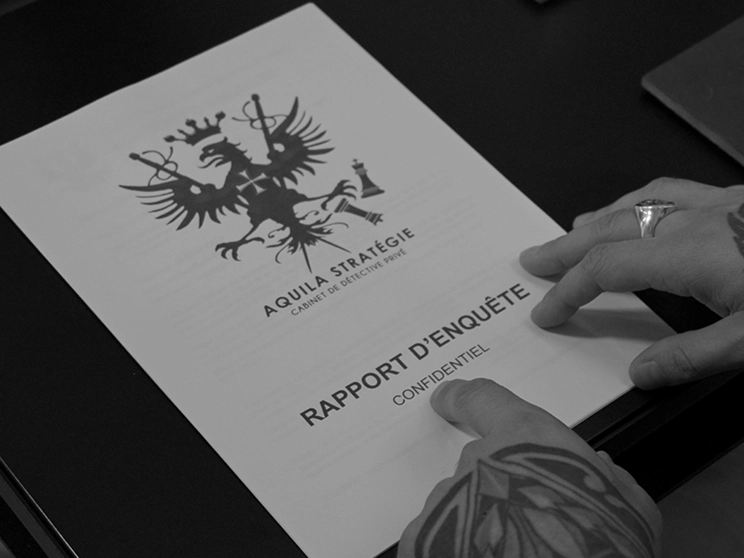
A summary report that can be used in civil litigation and criminal proceedings, submitted along with its documentary and photographic appendices.
Our membership in ALFA and our OSINT activities strengthen our network detection capabilities.
Why Should You Entrust Your Organized Fraud Case
to the Aquila Group?
The Insurance Investigation Division, led by Victor de Villeblanche, is complemented by the OSINT Division, led by Sarah Da Silva, a multilingual expert in conducting interviews. This combination of expertise is particularly well-suited to organized fraud cases that require both cross-referencing of open-source documents and fieldwork.
Our integrated national network, which does not rely on subcontractors, enables the coordinated deployment of personnel across multiple regions simultaneously—a capability that is rare in the French sector. When dealing with a fraud ring operating across four or five regions, this capability is crucial for gathering evidence in parallel rather than sequentially.
Our ALFA membership gives us access to reporting channels and industry standards, which are valuable operational tools in cases like these. Inter-company cooperation—in strict compliance with the legal framework—is often the key to dismantling a network.
- Dual Expertise: Insurance Investigation + OSINT, two integrated divisions.
- Simultaneous deployment across multiple regions is possible via the integrated national network.
- ALFA membership, access to reference databases and alert databases.
- A detailed report that can be used in civil and criminal court proceedings.
- A customized approach from the very first discussion with the division director.
ALFA centralizes alert data and facilitates cooperation among companies.
To contact our firm regarding a case of organized fraud, please use our dedicated form.
no obligation
Request your free quote
Frequently Asked Questions
There is no specific numerical threshold. The determination is based on the identification of a recurring pattern, recurring actors, and apparent coordination. Three cases exhibiting the same signature may be sufficient to trigger an investigation.
Yes, in strict compliance with contractual confidentiality provisions. The sharing of information between companies is always done through ALFA or with the express consent of the client companies.
Yes. The reports are prepared in accordance with the standards of fair evidence and may be attached to a complaint or submitted to a criminal court.
This varies depending on the scope and number of cases, generally ranging from four to eight weeks. The initial scoping meeting at the start of the investigation establishes specific milestones with the client company.
Through direct communication with Victor de Villeblanche, the division director. An initial telephone consultation helps determine whether a structured investigation is warranted.
Check out all our insurance claims sections





Be sure to check out our section on TSCM detection – Electronic dust removal for the detection of bugs and cameras, as well as ourOSINT digital investigation.